 As the days get darker, colder, and shorter, it is a common phenomenon to experience the winter blues, or its more severe form, Seasonal Affective Disorder (SAD). What exactly does it mean to feel the winter blues or experience SAD? Symptoms of the winter blues can include the following:
 Thankfully, there is a tool to use at home to help stave off or manage the effects of the winter blues or SAD: full-spectrum light therapy. This treatment has been found to be highly effective and with minimal side effects, and it is affordable and easy to use. You can purchase a full-spectrum light box for personal use online for under $30-$100, depending on the model and technological features. The light is most effective at a level of 10,000 lux bright-white fluorescence (with harmful UV rays filtered out), which is significantly brighter than typical lighting. Light exposure should take place first thing in the morning, within an hour of waking up, and for 20-60 minutes per day during the months of the year when daylight is diminished. The light should be close to the face (16-24 inches away), but the user need not stare directly into it for the effect. Light therapy should be completed every day, even on weekends, and at a consistent time for optimal effects. It often can take some time of regular use to feel the effects of it, so it requires a consistent routine. Light therapy can become a foundation for a morning self-care practice of taking some time for yourself in the mornings before getting started with your day. You can have it by you as you have breakfast, check the news, knit, catch up on emails, or however else you like to start your day - just be sure to use it within an hour of waking up to not interrupt your sleep schedule. I am not affiliated with any brands or marketing, but I can personally attest to Verilux for quality light therapy products.
Light therapy should be used with caution with certain medications or mental health diagnoses - always check with your medical providers and read manufacturer guidelines before starting any type of treatment. Some people may benefit more fully by using light therapy in conjunction with other treatments for SAD or depression, so it is important to explore all options for the care you need. To read more about light therapy, check out this overview from the Mayo Clinic. Have you considered, or have you tried light therapy yourself? Share your experience below.
0 Comments
 It's been a wild ride these last few months as the threat and then reality of the COVID-19 pandemic has hit full force. Here in Pennsylvania, we were notified only yesterday about a state-wide shut down of all non-essential businesses, which many others have been facing for far longer and with even more restrictions. As the situation unfolds, we are each faced with some hard choices to make as our worlds shrink smaller and smaller. Taking a proactive and intentional approach to social distancing and quarantine will be instrumental in finding peace and comfort in an uncomfortable situation. Following are some strategies to keep in mind to practice good self-care and promote emotional well-being during this challenging time:
 A few months back, I received an email from Lehigh (my PhD program and where I currently work as an adjunct professor) asking if I would be interested in teaching an eight-day course on group counseling for master's students in Kuwait. I paused and took account of my reactions to this question. Isn't it dangerous there? Would I feel uncomfortable as a foreign woman in the Middle East, alone? How would I connect with students from such a different culture, and within a society that has very different views on mental health? My stomach was performing anxious somersaults imagining this experience. However, I also noted a familial tingle of excitement - a different part of me was reawakening - the part of me that loves a challenge, embraces having my comfort zone stretched, and thirsts for experiencing something new and different, especially related to culture and travel. After a week of pondering, I made the decision to go.
I am currently on my fifth day here in Kuwait. I am curled up on a couch in the lobby of my hotel, sunlight and warmth streaming in from the big windows overlooking the city. I am feeling utterly fulfilled and refreshed as a professor of these brilliant, brave, and complex students. I am also feeling enriched and enamored with this country, the beauty of Kuwait City, and the vibrancy of the culture around me. I felt some culture shock when I first arrived here. Kuwait does not have a big focus on tourism - and it shows. The airport had minimal signage for people new to Kuwait. The public transportation system is also limited and difficult to grasp if you don't speak Arabic. There is no hop-on-hop-off bus or tourism offices to plan your visit. Thankfully, I had some help with a meet and greet service at the airport to help me get my visa sorted and to transport me to my hotel. Lehigh also made sure I had contacts both at home and here in Kuwait to make sure things ran smoothly. Upon arrival, I was immediately struck by how urban it is here - the city is packed with tall apartment buildings, endless high-end shopping malls, busy roadways, and enough honking to rival NYC. The buildings are varying shades of sandy beiges and browns, bedecked with the visages of the Emir, smiling and waving. While the city is, in theory, walkable, it is not always pedestrian friendly, and crossing streets can be an extreme sport. On my second day, I got to meet two of my students who offered to take me out for coffee and dinner, and to show me around the city. While sipping on an iced matcha latte, I could already feel the warmth and generosity of the social climate. My students answered all of my questions about Kuwaiti culture, expressed curiosity about how it felt for me being here, and gave me great pointers on everything from how to cross streets without having my life flash before my eyes, to where to find top-notch knock-off perfumes at the Mubarakiya Souk (Arabic market). My class includes nine students who represent as vast an array of cultural, religious, and lingual backgrounds as Kuwait City overall. Some hold very traditional and deeply held religious beliefs; others embrace more liberal and modern attitudes. Mental health here is in its infancy - there is deeply held stigma about mental illness and treatment for mental health problems. And yet, my students are defying stigma and opening themselves to learning about a topic that is not widely embraced within their culture. That takes courage. A significant aspect of our course is having an hour long experiential group that takes place during each class meeting. Students rotate being group leaders, and student members are themselves - no role playing or acting. I led the first group, but since that initial meeting I have been a group member as well. As each meeting has occurred, I have been able to see my students learn how to let go of their anxiety about the unknowns of what will happen in group, embrace the beauty of organic conversation and connection, and dig deep to share parts of themselves that they tend to keep hidden. Due to their diverse identities, this means something different for each student - however each one has taken courageous steps to find and embrace those common threads that hold us all together. These common threads are woven through sharing laughter, speaking in our home languages and explaining cultural sayings, discussing cultural values that shape our experiences and perspectives, and holding together shared emotions of anxiety, sadness, isolation, joy, empowerment, and connection that reflect a universal language. We are creating a tapestry as a group that is intricately textured, patterned, and infinitely colorful. I am already mourning the impending end of this teaching experience as it is already halfway to completion. However, I remain excited about where this journey will continue to go, and what other common threads will emerge along the way. Until this past Sunday, it had been years since we took my stepdaughter bowling. The last time we bowled, I remember wondering how her tiny eight-year-old fingers would ever be able to lift that six-pound ball. Somehow, she hoisted the ball, dangling it haphazardly from her little arm, and staggered to the line, her whole body off balance. She would swing the heavy ball with the shortest of arcs, and it would drop almost straight down in front of her with an ear-splitting clatter. Then, we'd wait. About 35 years later, the ball would finish its achingly slow commute, zig-zagging from bumper to bumper and finally, finally, hitting a pin so gently that it would pretty much bounce off it. To her delight, she'd knock over at least a few pins every. single. time. She'd spin around with unbridled glee, jumping up and down. As the proud parents we are, we'd join her in her excitement, providing endless high fives and verbal affirmations of her bowling prowess.
Fast forward to present day, and we had a less-unbridled, ultra-cool 13-year old joining us for bowling this time. While excited for the family activity, she was more measured in her outward display. On the way to the ally, we warned her that this would be her first time bowling without bumpers. After a moment of pensive reflection, she simply said, "Okay, that's fine." My husband and I glanced at one another and then readied ourselves for the game. I marveled when she chose a 10-pound ball and lifted it with ease. She started off our first set. We gave her the usual pointers about keeping her wrist straight, taking her time, trying not to drop the ball straight down on the ally. She seemed determined and confident. The first bowl was a disaster. Her wrist twisted, resulting in the ball careening sharply into the gutter. Next bowl, an exact replica of the first, except into the gutter on the other side. Three rounds in and she had accumulated a total of six gutterballs and zero points. My husband and I started to waver. Was she not ready for regular bowling? Should we ask to switch to a bumper lane? It was so hard to watch her keep trying, and keep failing. Time for the fourth set. Miraculously, the ball stayed straight, and she knocked over several pins. We were all over the moon! She jumped up and down, a replica of her eight-year-old self, despite being such a cool teenager. As the day wore on, she got better and better scores, doubling her tally between the first and second games. She was proud, confident, and quickly reclaimed her former bowling prowess. So, what if we had moved to a bumper lane? Sure, she would've had much better bowling scores (and my husband and I would have, also, if we're being honest...). But she would not have learned. She would not have been challenged to focus on her skills - her wrist stability, knowing how to slow her pace, lining her feet up properly with the pins. She would not have realized that she can learn, grow, and see her abilities bloom right before her eyes through her own hard work. In short, she wouldn't have had an opportunity to believe in herself. Bowling without bumpers gives us a perfect metaphor for why we should find ways to embrace the adversity we face. Just as our kid didn't grow in her skills and confidence without first failing and struggling, we don't grow and learn without facing some hardship ourselves. If we were to have everything we want without working, or struggling, or failing first to get there, we wouldn't value the things we have or the skills we demonstrate. As parents, it is easy to want to clear out obstacles that impede our children, or rescue them when they fail. It hurts to see your kids suffer. But when we clear out hurdles in their path, they never have a chance to strengthen their own muscles and realize that they CAN do it. It might not be pretty, and they might throw a few gutterballs, but they will eventually succeed. And that knowledge is priceless.  Unbelievably, the holiday season has returned again. It feels like just yesterday was back-to-school season, and here we are, up to our necks in turkey and mashed potatoes, shivering in the blustery cold weather. This time of year tends to be a mixed bag for many. It can bring joy, hope, and optimism through delicious meals, time spent with family, beautiful decor, and anticipation for happy memories. It can also bring an increase in stress, however, due to immense pressures of preparing food, hosting guests, traveling, navigating crowded roads and stores, spending money, and engaging with family who may not be your ideal companions. For others, it can be a time of profound loneliness and grief due to family estrangement or conflict, coping with the loss of a family member, or battling seasonal mood symptoms. For many, it can be a whirlwind mix of all of the above. Let's go over a few quick tips to help navigate this assortment of emotions and make the most of the holiday season.
What helps you get through the holiday season in one piece? Share your thoughts in the comments. Wishing you a joyful and mindful season! Anxiety disorders, which include everything from generalized anxiety, to social phobia (aka, social anxiety), to obsessive-compulsive disorders, are the most commonly diagnosed mental health problem in the US. In fact, according to the Anxiety and Depression Association of America, anxiety disorders affect 40 million US adults. More disheartening is that less than half of those with anxiety disorders receive help for their struggles. When I work with clients who have anxiety, I often discuss with them the cycling and self-reinforcing patterns that anxiety tends to induce. This three-part series will review common ways that we give in to, and therefore worsen, our anxiety. Part 3: Self-Medicate It Anxiety can be exhausting, grueling, and overwhelming. It consumes copious amounts of physical energy and mental space. Many clients describe their racing thoughts as a track running constantly in their minds at 100 miles per hour, taking up valuable room that could be used for more productive things. In Part 1, we discussed what anxiety is and the value of insight. In Part 2, we reviewed the negative effects of finding ways to avoid anxiety triggers, which only serves to make anxiety worse in the long-run. However, avoidance is only one of many less-than-helpful ways of coping with anxiety. The discomfort of anxiety offers tempting invitations to find quick fixes for relief. Those facing physical exhaustion from anxiety-induced sleep issues or fatigue may grab a few extra cups of coffee or a Red Bull to get through the day. Some who always feel keyed up or tense may look to alcohol or other drugs to take the edge off. Still others turn to what they can control and rely on - food, shopping, social media - to provide distraction or comfort. Let's break down some of these quick-fix anxiety responses that may not be so helpful for long-term symptom reduction:
Something to try: A saying I use often with clients is to strive to find your comfort within life's discomfort. We have no way to ensure life will be smooth and easy; in fact, it tends to be just the opposite - but that's what makes our lives meaningful. We are tasked with finding ways to cultivate a sense of peace even when our lives feel far from peaceful. When you are feeling anxious, practice closing your eyes, taking some measured breaths, and mentally stepping back so you can appraise your situation from a different perspective. Try to hold in your mind the realities of whatever discomfort is causing your distress, but also hold your grit - your inner strength and resilience - and remind yourself that you can lean into the discomfort with grace and persevere. Breathe through the discomfort and notice how even in the midst of our tumultuous worlds, we can still hold peace within. I hope you enjoyed this three-part series on anxiety! Are there other topics you'd like to learn more about? Share them below or reach out. Anxiety disorders, which include everything from generalized anxiety, to social phobia (aka, social anxiety), to obsessive-compulsive disorders, are the most commonly diagnosed mental health problem in the US. In fact, according to the Anxiety and Depression Association of America, anxiety disorders affect 40 million US adults. More disheartening is that less than half of those with anxiety disorders receive help for their struggles. When I work with clients who have anxiety, I often discuss with them the cycling and self-reinforcing patterns that anxiety tends to induce. This three-part series will review common ways that we give in to, and therefore worsen, our anxiety Part 2: Give Into It By far the most common anxiety mistake I see people making is giving into it. As I reviewed in Part 1, anxiety often boils down to a misapplied fight-or-flight response to a threat that isn't truly life-or-death. It is a good thing that we have fight-or-flight, as it keeps us from harm through readying our minds and bodies for action or escape. However, sometimes that response can get linked up with things we face in life that are not actually threatening enough to warrant such a strong neurobiological response (e.g., meeting new people, public speaking, spiders, unknowns, compulsive behaviors, being imperfect, etc.), resulting in a state of anxiety. When we are in an anxious state, our minds and bodies are basically screaming at us to get ourselves OUT of that situation through trying to find things to control (hello, perfectionism!), numb the anxious feeling (hey there, comfort food), or avoid the threat altogether. This post focuses on the danger of avoiding the anxious trigger. What happens when we listen to our screaming brain and simply avoid the trigger? Avoidance often gives us immediate relief from anxiety, but it does us no favors in terms of making our anxiety better. In fact, it seems to make it worse. By giving in and avoiding the trigger, we reinforce our brains, telling ourselves that yes, this threat I am facing truly is life-or-death, and we give our fight-or-flight response a pat on the head (brain?) for a job well done. The next time we face the same trigger, our brains will respond as actively, if not even more so, as the first time we faced it because we reinforced the fear by giving in. So what should we do instead? Face the fear directly. Anxiety lives on a bell curve (see below) - it builds up with those initial signs (the red zone) and continues to grow in intensity (the orange). Often, we look for ways to cut those anxious feelings before it crests - we become afraid of our own anxiety - through avoidance, numbing, or control. However, if we can muster our inner strength to sit in the discomfort of anxiety, it will subside. The acute anxiety state does not last forever, and the more that we face the threat, breathe, and ride the wave, the less intense our response will get every time we face our fear. 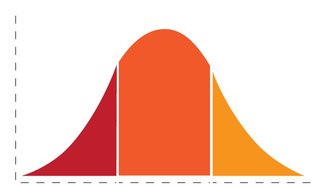 I experienced success with facing fear head on when it came to public speaking. Back in high school and college, I would be an absolute mess when I had to present a speech in front of my class. Shaking hands, quivering voice, cold sweat, that gripping, hollow feeling in my stomach like when you miss the last step on a staircase - all that good stuff. However, I kept pushing myself to face, acknowledge, and ride out those anxious feelings every single time. Over the years my discomfort became more manageable, and I have since completed some pretty big milestones, including conference presentations, my dissertation defense, and currently teaching graduate students for the sixth semester in a row. I still get butterflies, but my fight-or-flight response is far more subdued and manageable - and I fully attribute it to facing my public speaking fear and telling my brain over and over, "This makes me feel some stress, but I know I will be okay. Let's channel these nerves into excitement and get on with it."
Something to Practice: Identify a trigger for your anxiety response. Sticking with my anecdote above, we will use public speaking for an example.Then, think about a step towards conquering that fear. The first step should be anxiety-provoking enough -- but not overwhelmingly so. For example, one step towards conquering public speaking fear might be raising your hand in class. Then, schedule 3-5 times this week to practice facing that initial step without avoiding it. Keep track of your anxiety symptoms before, during, and after - and notice how they will decrease in intensity with repeated exposure. Once you get to the point where raising your hand no longer elicits substantial anxiety, move to the next step, such as attending a networking event or job fair, or taking a lead role for a class presentation. Work your way systematically through these steps and watch the anxiety drop. Extra resources: More about fear exposure for social anxiety Treating phobias with fear hierarchies More on anxiety and fight-or-flight Have you been able to conquer any of your fears? Share your success stories in the comments! Anxiety disorders, which include everything from generalized anxiety, to social phobia (aka, social anxiety), to obsessive-compulsive disorders, are the most commonly diagnosed mental health problem in the US. In fact, according to the Anxiety and Depression Association of America, anxiety disorders affect 40 million US adults. More disheartening is that less than half of those with anxiety disorders receive help for their struggles. When I work with clients who have anxiety, I often discuss with them the cycling and self-reinforcing patterns that anxiety tends to induce. This three-part series will review common ways that we give in to, and therefore worsen, our anxiety. Part 1: Ignore It Ignorance is definitely not bliss when it comes to understanding what your mind and body are doing when you feel anxious. I think about anxiety (vs. appropriate fear) as an incredibly valuable neural response that is being either overblown or misapplied. In other words, the sensations that accompany an anxious state (accelerated breathing and heart rate, sweaty palms, muscle tension, decreased or increased appetite, racing thoughts, adrenaline rush) are highly useful when we are faced with actual threats to our safety or well-being. These bodily and cognitive changes represent our fight-or-flight response that readies us for survival in threatening situations. Our bodies are poised for action with activated muscles and quick respiration and heart rate, and our thoughts are running on high speed to alert us to our surroundings and possible ways to escape. Think about how adaptive this response is, especially remembering what life was like for the original humans fending off vicious predators and fighting for the survival of our species.
However, anxiety happens when that fight-or-flight response is misapplied to situations that aren't actually threatening to our safety, or at least not threatening enough to truly need that type of response. This is where having insight into what is happening mentally and physically can give you some leverage with anxiety - it gives answers to what you are feeling, it fights "anxiety about anxiety" (e.g., thinking you may pass out or die due to how your body feels in a state of fight-or-flight), and it opens up the possibility for challenging your anxious thoughts and practicing physical relaxation training to regain a sense of calm. Truly, knowledge is power when it comes to managing anxiety. Something to practice: If you are feeling anxious or even just stressed out, try to pause for a minute and notice what is going on in your body and mind:
Keep an eye out for Part 2, which will discuss how giving in to our fears exacerbates anxiety. What strategies do you use to manage stress and anxiety? Share your go-to coping methods in the comments below. We hear the word "depressed" thrown around frequently these days, applied to many situations that may or may not relate to true depression. We also hear terms like "clinically depressed," "major depression," or simply "depression" when describing mood diagnoses. This post will break down how to differentiate between situational sadness, typical mood fluctuations, and the mood disorder known as Major Depressive Disorder.
It is a normal and expected part of life to have ups and downs in mood. To feel sad when disappointed by someone, to be burdened by grief after a major loss, to feel frustrated and angry at a boss, to feel defeated when getting a low grade on an exam; these are typical human reactions to life's many stressors. As Buddha said, life is suffering. So, we can expect those fluctuations within our days and weeks. However, a persistent low mood can reflect something beyond situational sadness. This is the point at which we look at the possibility of a Major Depressive Disorder (MDD), which is how depression is currently diagnosed. To be diagnosed with MDD, you must meet at least five of the following criteria:
If you or someone you know seems to be struggling with MDD, it is important to seek help. Untreated MDD can spiral into more severe symptoms, greater impairment in functioning, and increased risk of suicide. Psychotherapy is great resource to manage symptoms depression. Others utilize medication, which is most effective when combined with psychotherapy. There are also exciting new treatments on the rise, including Repetitive Transcranial Magnetic Stimulation (rTMS) and physician-administered psychoactive drugs, such as Ketamine, that are being implemented for treatment-resistant cases of MDD. Here's to a brighter future and better treatment for MDD. Thanks for reading! |